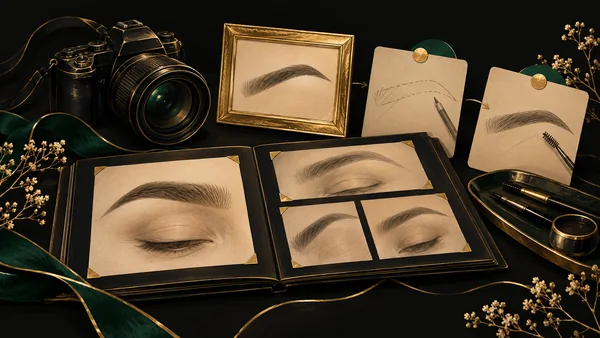


A good portfolio helps you understand an artist's aesthetic, but a photograph deserves more careful reading than an ordinary feed image. Colour and symmetry matter, but so do the caption, treatment stage, lighting and starting features. Two works can be compared fairly when it is clear what each photograph shows.
Ask about the stage first
A photograph immediately after treatment and a photograph of a healed result answer different questions. The first shows newly completed work; the second helps discuss its later appearance. Clarify when the image was taken, whether a touch-up preceded it and whether it shows the same person as the “before” photograph.
Do not identify the stage by brightness alone. “Healed lips” should be a clear statement from the author, not your assumption. Nor should a portfolio be used to assess your own symptoms: someone else's photograph is not a medical consultation and does not confirm that your situation is the same.
Check the photographic conditions
Images with similar angles, distance and lighting are helpful for comparison. Warm light, cool light, shadows and camera settings can change the impression of a shade. If the face is turned in one image and photographed straight on in another, comparing shape is harder too.
Ask to see the result without makeup on the relevant area and without a skin-smoothing filter. Ordinary exposure adjustment and retouching the work itself have different implications for viewers. You do not need to investigate every photograph, but it is reasonable to ask whether colour, outline or texture was changed. An honest explanation matters more than a flawlessly uniform style across all images.
Look beyond an attractive detail
A close-up shows detail, while a wider image helps place the result in the context of the face. For brows, it helps to assess both sides together. For lips, look at how the shade works with the rest of the appearance. However, clients have the right to decline publication of their whole face: the absence of such a photograph does not itself indicate a problem.
Look for several works with similar aesthetic aims rather than an exact match to your features. A portfolio shows a range of solutions but does not guarantee reproduction of someone else's result. “I like the soft start of the brow” or “I want to discuss a muted colour” is more useful than demanding a copy of a photograph without regard to your own appearance.
Do not reach a final conclusion from one particularly successful image. Look at several examples in succession: do you like the overall approach to definition, are the explanations clear, and is there work with different starting features? This helps separate your own aesthetic preferences from the effect of attractive presentation.
Make a short list for the consultation
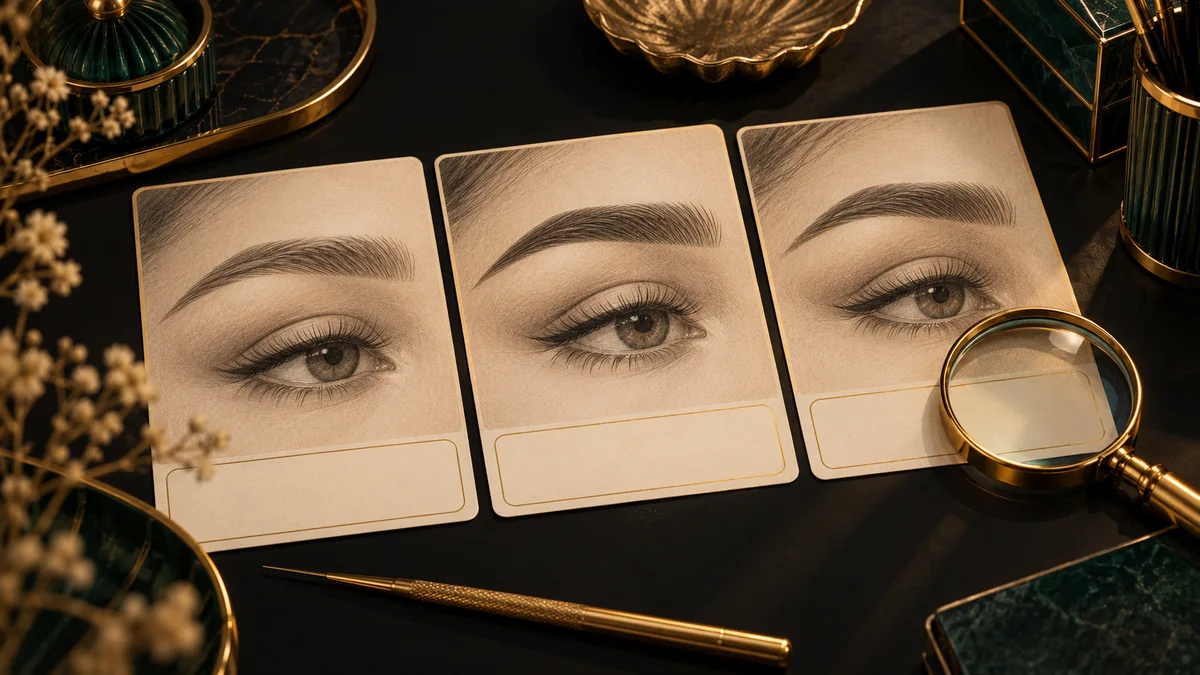
Choose three examples: one close to what you want, one too defined and one too subtle. Add a short explanation to each. This shows the artist not only your preferences but also the boundaries you do not want to cross. It is more useful than a large folder of conflicting references without comments.
When exploring Anita Space's lip gallery, note which works you would like to discuss personally. If the stage or photographic conditions are not labelled, simply ask. A thoughtful portfolio review ends not with a ranking of the “most beautiful photo” but with a clear conversation about your wishes, available options and realistic expectations.