

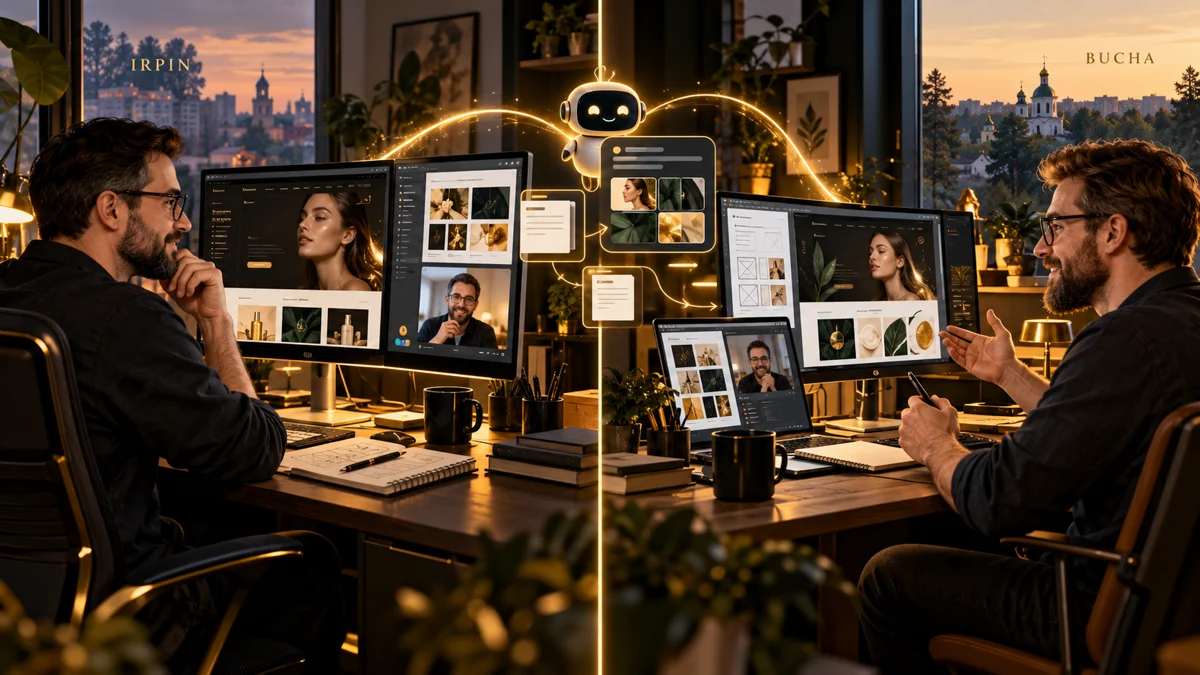
According to the project owner, ANITA SPACE is being developed by two men around forty, both bearded and wearing glasses. One works in Irpin, the other in Bucha. MICHAEL & Di and Alex and Sidora Company create the site together, but not at the same desk: they collaborate remotely. They agree on decisions, send mockups, exchange Google Docs and working boards, and use a ChatGPT agent to help process revisions.
A shared board instead of a shared desk
Remote work needs a clear reference point. A mockup conveys composition, a document holds the copy, and a board helps compare alternatives. A comment such as “make it more distinctive” becomes more useful beside a specific button, photograph or heading. In this exchange, it matters to distinguish a suggestion from an agreed version, avoid mixing files and return revisions to their shared context. We are not publishing private documents or invented conversation screenshots: the article explains the working logic without exposing anyone’s workspace.
From mockup to a working website
Exchanging files should lead to a clear visitor experience. Services, training, the gallery and the journal answer different questions, so they should not merge into an endless feed. Black-and-gold styling is about more than effects: names need to be readable, courses accessible through visible cards, and photographs authentic. Spacing and button sizes are considered within the page. Something impressive in a standalone mockup may need a quieter treatment on a phone.
ChatGPT assists; people make the decisions
In this process, a ChatGPT agent helps with wording, structure and revisions. Its role is to support discussion and implementation, not invent Anna’s biography, verify unknown facts or claim results for the project. Content and the suitability of materials still need human review. A useful working principle is to state the task, provide context, inspect the result and only then accept a change. The illustration of two workspaces explains this approach; it does not document what the actual rooms look like.
Seven languages and a useful next step
Ukrainian is the main language, with Russian, English, Polish, Japanese, Romanian and German versions also available. Switching languages should retain the page’s subject rather than send visitors back to the beginning of their search. On smaller screens, reading, menu access and clear contact options take priority. Opening a messenger or making a phone call is not a confirmed appointment: arrangements are agreed with Anna personally.
Room to grow without becoming overloaded
Future additions should follow the same logic: select informative material, avoid repeating the same subjects and optimise images rather than load an entire library on every page. A good website does not need promises of guaranteed search positions or sales. Its practical value is to help people find their bearings, see what matters and ask their next question. Learn more about the studio involved in the project on the MICHAEL & Di website.